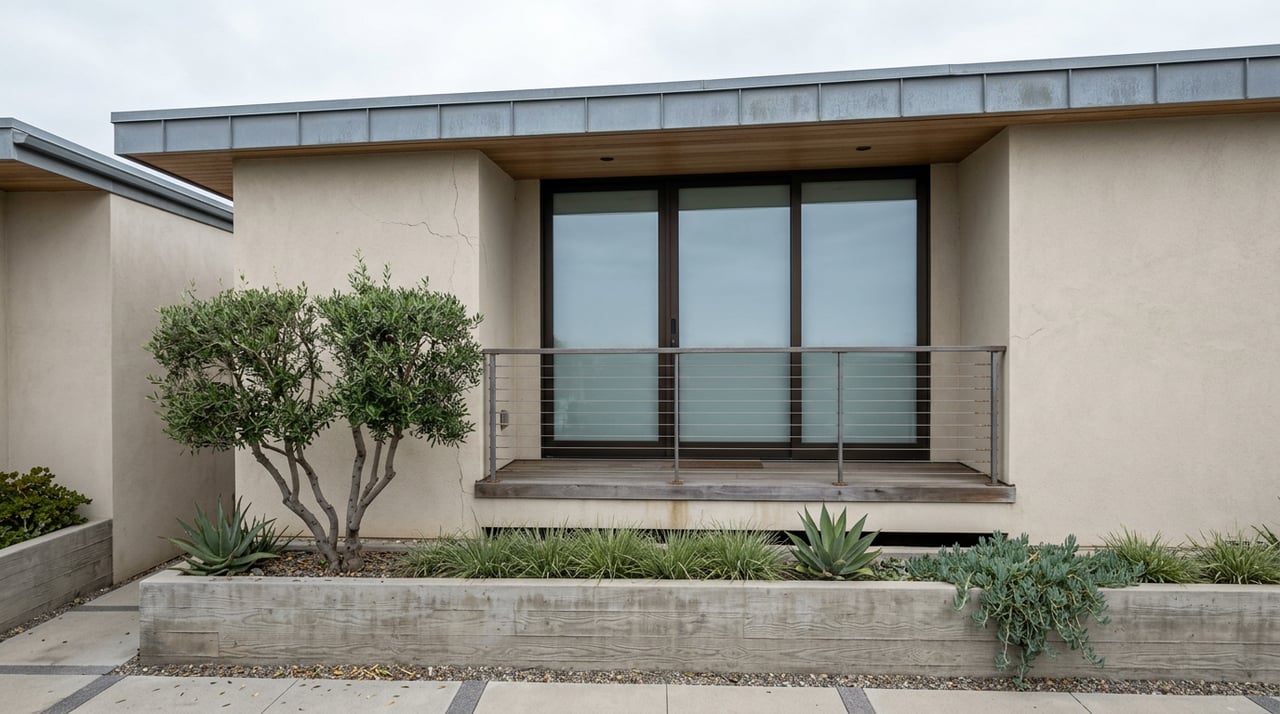
On a trapezoidal corner lot at 657 and 659 Sunset Avenue in Venice's Oakwood neighborhood, a one-story duplex and a two-story duplex, four units in total, are approved to come down. In their place: a four-story building measuring 48 feet 7.5 inches tall, holding 25 units on a 9,415 square foot lot, with 11 parking spaces. Two street trees that once stood on the site are already gone.
If you've priced a small multifamily lot in Venice and checked the posted height limit for Oakwood, that number is 25 feet for a flat roof and 30 feet for anything with a stepped-back or varied roofline. The building rising on Sunset Avenue is more than 18 feet over that ceiling and holds more than six times the unit count of what stood there before. Understanding how that happened is worth your time if you own, or are considering buying, a modest lot anywhere in Oakwood or along the Marina Peninsula, the only two parts of Venice where this particular gap between the printed zoning and the approved building tends to show up.
The Number on the Zoning Map Isn't the Number the City Used
Venice's Local Coastal Program designates the Sunset Avenue site as Multi-Family Residential, Low Medium I Density, under Policy I.A.6. That policy caps building height in Oakwood at 25 feet for flat roofs and 30 feet for stepped-back or varied rooflines. One long-standing community institution nearby was granted an exception up to 43 feet in recognition of its role serving the neighborhood, but that exception was treated as unusual enough to note by name in the Coastal Commission's own staff report.
The Sunset Avenue project didn't ask for an exception. According to the Commission's staff report on the appeal, the city calculated density using the site's broader land use designation rather than Oakwood's specific policy, then applied density bonus provisions tied to affordable housing under the local municipal code. Stack those two together and the math produces a building the neighborhood-specific rule alone would never allow. Of the 25 approved units, 19 are priced at market rate and 6 are reserved for very low income households, the incentive that unlocked the additional height and density in the first place.
| Oakwood's Policy I.A.6 | 657 Sunset Avenue as Approved | |
|---|---|---|
| Height, flat roof | 25 ft | 48 ft 7.5 in |
| Height, varied roofline | 30 ft | not applicable |
| Units on site before | 4 | demolished |
| Units approved | not specified | 25 |
| Parking spaces | not specified | 11 |
| Lot size | not specified | 9,415 sq ft |
Why 2001 and 2026 Don't Fully Agree
The Venice Land Use Plan was certified by the California Coastal Commission on June 14, 2001. It has guided Coastal Zone decisions in Venice ever since, but it was written before the current strength of California's density bonus law existed. Los Angeles City Planning is now working on an updated Local Coastal Program for Venice, in part to account for newer state housing law, and expects to release a draft Land Use Plan for public review in the second half of 2026.
Until that update is certified, every project in Venice's Coastal Zone gets measured against two documents that don't fully talk to each other: a 25-year-old neighborhood plan with specific height caps, and current state density bonus law that rewards affordable units with more height and more square footage than the plan anticipated. The Sunset Avenue project sits exactly at that seam, and it won't be the last one to.
The Precedent Next Door
Part of why Coastal Commission staff recommended finding no substantial issue with the appeal is what's already standing beside the site. At 653 and 653½ East Sunset Avenue, two structures share a single lot: a three-story building at the rear that reaches 37 feet, rising to 45 feet including a roof access structure, and a separate two-story building at the front. Staff pointed to that existing scale as evidence the block already contains buildings larger than a strict reading of the 25 to 30 foot cap would suggest, which weighed against the appellants' argument that the new project would be out of character for the street.
The appeal itself was filed by Dr. Naomi Nightingale and Margaret Molloy, residents of the block, under Coastal Commission Appeal No. A-5-VEN-26-0003. Their objections centered on the building's mass relative to Chapter 3 of the Coastal Act, the sufficiency of 11 parking spaces for 25 units in a neighborhood where street parking is already tight, and the two street trees that were removed from the site before the permit was finalized, a sequence their appeal flagged directly as troubling.
What "No Substantial Issue" Actually Means for a Buyer
A Coastal Commission appeal doesn't automatically mean a project stalls. Once an appeal is filed, staff reviews it and issues a recommendation. If the Commission agrees there's no substantial issue, the local approval stands and the project moves forward as the city approved it. If the Commission finds a substantial issue instead, the matter moves to a full de novo hearing where the Commission itself reviews the project against Coastal Act policy from scratch.
The Commission's own guidance on the appeal process is direct about the odds: most projects that reach the appeal stage are still approved, often with revised conditions rather than an outright denial. That matters if you're evaluating a listing near an appealed project, or wondering whether a redevelopment plan of your own might draw similar opposition. A live appeal buys neighbors a hearing and a public record. It does not, by itself, buy them a different outcome.
What This Means If You're Evaluating a Small Lot in Oakwood or the Marina Peninsula
A few things worth doing before you write an offer, or before you price a lot you already own:
- Pull the parcel's specific Local Coastal Program designation, not just the general Oakwood height number. The city's own approval on Sunset Avenue relied on the broader land use designation rather than the neighborhood-specific policy, and that distinction changed the outcome.
- Ask whether a density bonus application has been filed or approved on the parcel or on adjoining lots. That single filing can move a building's ceiling well past what's posted for the area.
- Look at what's already built next door. Commission staff treat existing large structures as the yardstick for neighborhood character, so a lot beside a taller building carries a different redevelopment ceiling than one surrounded entirely by one-story homes.
- If you're pricing a small multi-unit lot for sale, run the density bonus math before you set the number. Two lots that look identical in a listing can carry very different buildable potential once affordable-unit incentives are factored in.
- If you're a neighbor watching a nearby project move through appeal, know that the filing guarantees a hearing, not a different result, particularly when a comparable structure already stands close by.
We touched on some of this complexity in our earlier look at what's driving Venice home prices right now, where coastal permitting timelines and historic overlays already factor into how buyers should think about micro-location. The Sunset Avenue case adds a sharper point to that picture: the printed zoning cap is a starting position, not a guarantee, on either side of the property line.
Frequently Asked Questions
Does this density bonus dynamic apply anywhere else in Venice? The specific Oakwood policy at issue here governs Oakwood's designated area. California's density bonus law applies statewide, so similar stacking of a broader density designation with an affordable-housing bonus can show up anywhere in the city. Because Los Angeles is still drafting its updated Local Coastal Program implementation plan for Venice, confirm the current rule for any specific parcel with the city planning department rather than relying on the 2001 Land Use Plan alone.
What is a density bonus, in plain terms? California's density bonus law allows a project to include more units, and often more height, than the base zoning permits, in exchange for setting aside a percentage of those units for lower income households. At 657 Sunset Avenue, that meant 6 of the 25 approved units are reserved for very low income tenants.
Does an active Coastal Commission appeal mean a project won't get built? Not usually. The Commission's own process guidance notes that most appealed projects are still approved, sometimes with revised conditions. Filing an appeal secures a hearing and a public record. It does not reliably change the outcome, especially when staff can point to a comparable structure already standing nearby.
If you're weighing a purchase in Venice's Coastal Zone, or trying to understand what a small lot in Oakwood or along the Marina Peninsula is actually worth once density bonus rules are factored in, that's exactly the kind of paperwork our team at Jasan Sherman works through with clients before an offer goes in, not after. Start with a conversation about your specific parcel, or get an instant Westside home valuation to see where your property stands today.
