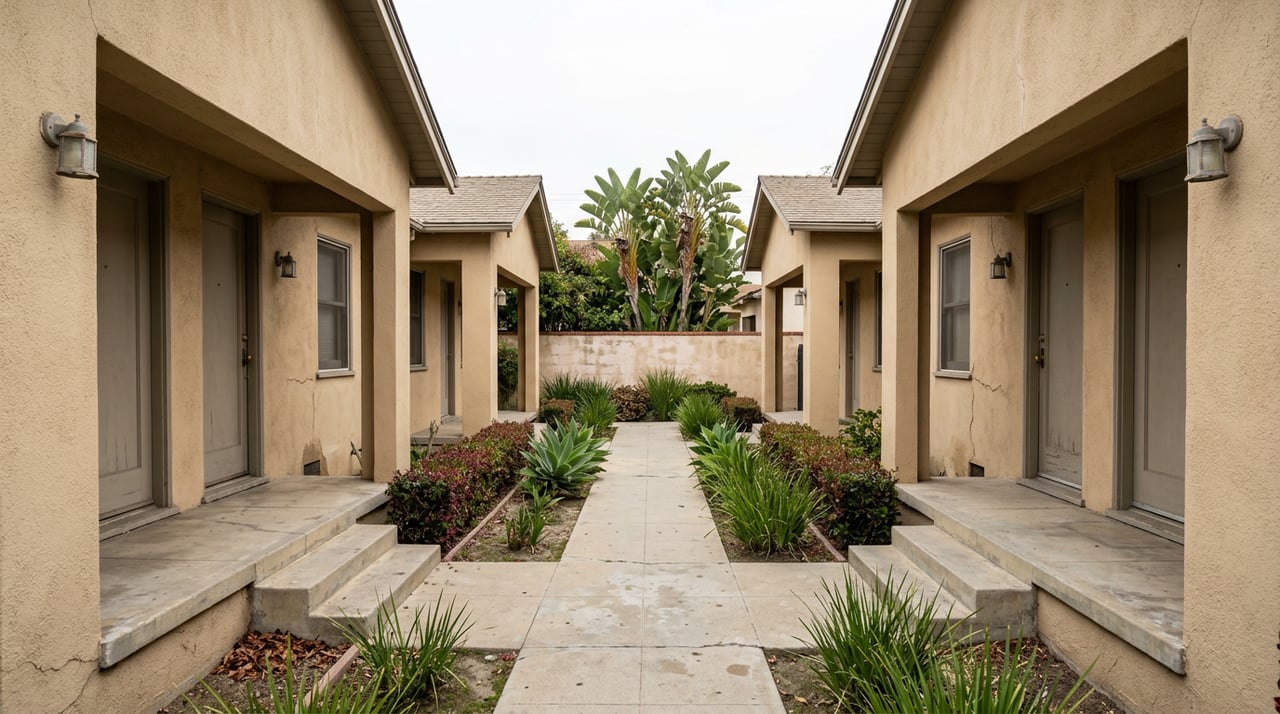
If you're underwriting a rental purchase in Venice right now, start with this: nothing new got built here, and rents fell anyway.
That should not happen. The standard investor logic for a coastal, land-locked neighborhood like Venice runs in one direction. No new construction means no added competition for tenants, which means landlords hold pricing power even when the broader Los Angeles market softens. It is the reason so many buyers treat Venice as a defensive play, a place where scarcity does the heavy lifting on rent growth.
A Los Angeles rental market update published in July 2026 told a different story. Venice saw zero new construction and average asking rents still declined, falling roughly 2.2 percent year over year to about $3,303. No new supply. Falling rents. That combination is the whole thesis of this post, and it changes how you should think about a Venice rental purchase today.
The numbers don't agree, and that's the point
Ask three different platforms what a Venice rental actually costs and you'll get three different answers. As of July 2026, Zumper put the average Venice rent at $3,500, down 29 percent from a year earlier. RentCafe, updated the same month, showed $3,381, essentially flat, down just 0.05 percent year over year. The Westside rental market report cited above landed in between at $3,303, down 2.19 percent.
None of the three shows rent growth. All three disagree sharply on how much rent fell. That gap tells you something useful before you even get to the why. Platforms build their averages differently: some track new listing asking rents on a rolling window, some blend renewals with turnover units, some weight by unit size or building age differently than others. A 29 percent drop and a flat reading covering the same month, the same neighborhood, and roughly the same rent level cannot both be describing the same underlying market movement. The honest read is that the direction is consistent and the magnitude is noisy, which means any single number a listing agent or a Zestimate-style tool hands you deserves a second source before it goes into your pro forma.
Why rents softened without a supply glut
The Westside report's own explanation is the part worth sitting with. It frames the Venice decline as a ceiling effect rather than a supply story. Renters in a market where the largest share of tenants already pay north of $3,000 a month are running into the limit of what their incomes can absorb, regardless of how tight the vacant unit count is. You can have a genuinely supply-constrained neighborhood and still see rents stall or slip if the tenant pool simply cannot stretch further.
That distinction matters for how you model growth going forward. A supply-driven softening usually resolves once absorption catches up, and a savvy buyer can underwrite a recovery timeline with some confidence. A ceiling-driven softening resolves only when tenant income catches up to rent, which is a slower and less predictable variable. If you're buying a Venice duplex or a small multifamily building on the assumption that scarcity alone will push rents back up within a year or two of ownership, the July 2026 data doesn't support that assumption. The scarcity is real. The pricing power from it is not showing up in the numbers right now.
What a softening rent roll does to your math
Los Angeles multifamily cap rates in 2026 have generally run in the 5.0 to 5.6 percent range, with prime, well-located assets trading closer to the mid-4 percent range and higher-risk or older-condition properties pushing past 6 percent, according to a Westside commercial real estate report published in March 2026. That range only holds if the net operating income behind it is real.
Here is where the Venice numbers bite. If a seller's rent roll or listing pro forma is built on last year's asking rents rather than this year's actual collections, the cap rate you think you're buying is not the cap rate you're actually getting. A building priced to a 5.2 percent cap rate on stale rent assumptions could be closer to 5.0 percent or lower once you plug in current, softened rents. That is not a reason to walk away from Venice. It is a reason to ask for trailing twelve month actuals, not asking rent comps, before you commit to a number.
The two rent control regimes you're actually buying into
Underneath the rent numbers sits a regulatory layer that determines how much room you have to respond if rents stay soft or the building needs repositioning. Which regime applies depends entirely on when the building got its certificate of occupancy, and it is worth confirming before you write an offer, not after.
- Buildings with a certificate of occupancy on or before October 1, 1978 fall under the City of Los Angeles Rent Stabilization Ordinance. As of February 2, 2026, the RSO's allowable annual increase sits at 3 percent, and landlords can no longer add the extra percentage points previously allowed for utilities paid on a tenant's behalf. That 3 percent is now the entire lawful ceiling, whether the building has two units or forty.
- Buildings constructed after 1978 that are older than 15 years and not otherwise exempt typically fall under California's statewide Tenant Protection Act, AB 1482, which caps annual increases at 5 percent plus the regional Consumer Price Index, up to a maximum of 10 percent.
Venice has a substantial stock of older, small multifamily buildings, so plenty of Venice rental purchases will land under the tighter RSO cap rather than the more flexible AB 1482 formula. That single date on the certificate of occupancy shapes how quickly you can move a rent roll toward market even if market rents eventually recover.
The ownership structure that quietly cancels your exemption
Single-family homes and condos are generally exempt from AB 1482's rent cap and just cause eviction rules. Many out of area and first time investor buyers assume that exemption travels with the property type. It does not.
California law removes the single-family and condo exemption from AB 1482 the moment the property is owned by a corporation, an LLC with a corporate member, or a real estate investment trust. An investor who buys a Venice single-family rental through a standard LLC, the entity structure most advisors recommend for liability protection, can lose the exemption they were counting on and find the property subject to the same statewide rent cap as a multifamily building. If you're structuring the purchase through an entity for tax or liability reasons, get clarity on how that structure interacts with AB 1482 before you close, not after your first rent increase notice goes out.
What this means before you make an offer
A Venice rental purchase in 2026 is not a bad idea because rents softened. It is a different underwriting exercise than it would have been two years ago. Verify actual trailing rent collections rather than asking-rent comps. Confirm the certificate of occupancy date and which rent control regime governs the building. Check how your intended ownership structure interacts with the AB 1482 exemption before you assume it applies. None of that shows up in a median rent headline, and all of it changes what the property is actually worth to you as an income asset.
A couple of questions worth asking directly
Does a rent decline mean Venice is a weak investment market? Not on its own. It means the pricing power investors often assume comes automatically from land scarcity is not showing up in the current rent data, so growth assumptions need real support rather than a general belief that coastal neighborhoods always appreciate.
How do I find out if a specific Venice property is RSO covered or under AB 1482? The determining factor is the certificate of occupancy date for the building, which should be confirmed through city records or a title company as part of due diligence, not assumed from the building's age or appearance.
Rental underwriting in a market like this rewards the buyer who checks the actual numbers over the one who trusts the headline. If you're evaluating a Venice duplex, small multifamily building, or single-family rental and want a read on what the real rent roll and regulatory picture look like for a specific address, the Jasan Sherman team works these streets and these deals directly. Get your instant Westside home valuation to start the conversation with real numbers instead of a platform average.
